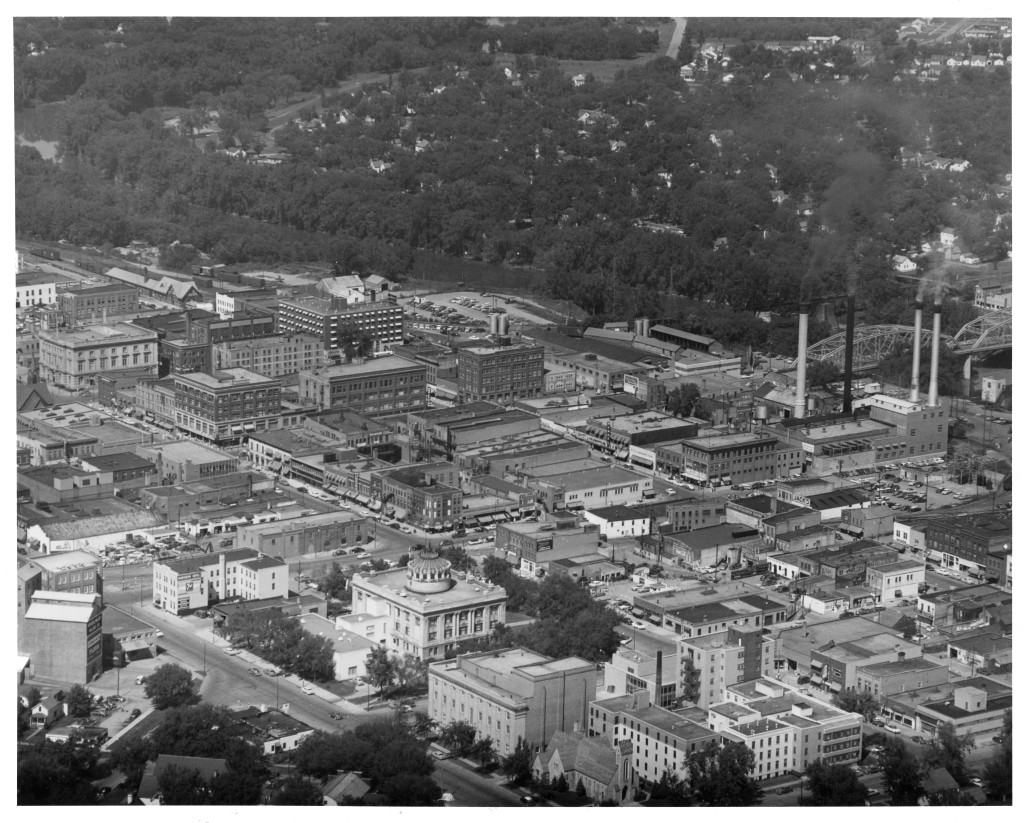
Aerial view of downtown Grand Forks, 1957.
"Les Grandes Fourches" A centuries-old gathering spot for Plains Tribes. A trading post for trappers, traders, and ox-cart drivers carrying goods from St. Paul to Winnipeg. The name was anglicized to Grand Forks when a postmaster was appointed for the area in 1870. A year later, the Red River Stage Line from Abercrombie to Winnipeg started up; about that same time flat boats began carrying freight north out of Minneapolis and St. Paul. Riverboat Captain Alexander Griggs wintered at Grand Forks in 1872, returning in 1875 to lay out the first plat lines for the town. Griggs' platted area roughly corresponds with the boundaries of the Downtown Historic District.
Early Grand Forks was a river town, nestling along the western bank of the Red River of the North. The river was used for trade, travel and supplies, providing all the necessities of a frontier town. Soon, however, development became tied to the arrival of the railroads and the major highways that still intersect the city.
By 1887, the Great Northern Railroad (originally the St. Paul, Minneapolis & Manitoba) and the Northern Pacific supplied access north, south, east and west. They positioned Grand Forks for its heyday as a merchandising and warehousing hub. Downtown expanded to the north and west along the tracks and trains quickly usurped the river's dominance. North 3rd Street developed into the hub of a large warehousing district that temporarily stored produce, farm implements, and domestic products from the coasts before shipping to outlying areas of North Dakota, Manitoba and northern Minnesota.
Automobiles became more affordable and popular just as the warehousing functions moved out of downtown. As a result, many warehouses were converted to auto dealerships and garages. Once again, Grand Forks found itself at the intersection of two great transportation routes: the Meridian Highway (now Highway 81), from Canada to Mexico, and Highway 2, the northernmost U.S. route from Maine to Washington state. This easy access facilitated tourism, business travel and trucking.
...
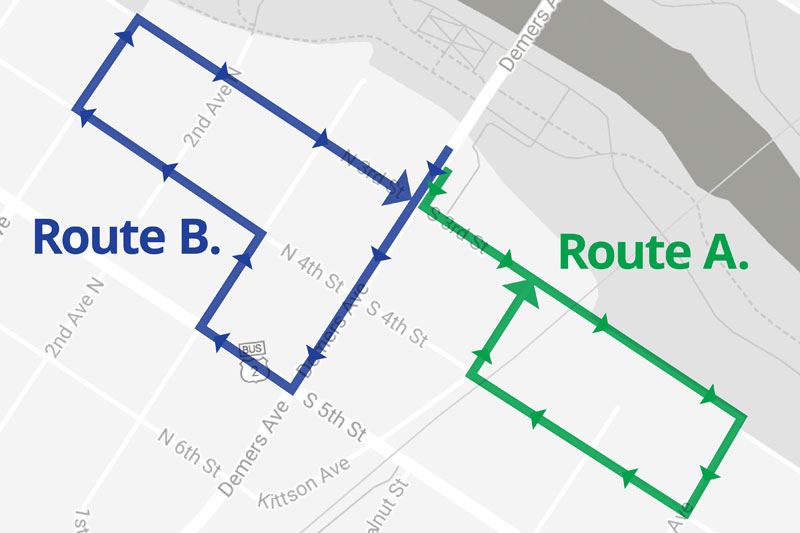
Begin Route A: SE from Town Square
Explores the earliest retail district and includes the Metropolitan Opera House, Masonic Temple, and County Courthouse. Eight blocks.
Begin Route B: SW from Town Square
Explores the manufacturing/warehousing district and includes the Federal Building, Central High School and City Hall. Ten blocks.